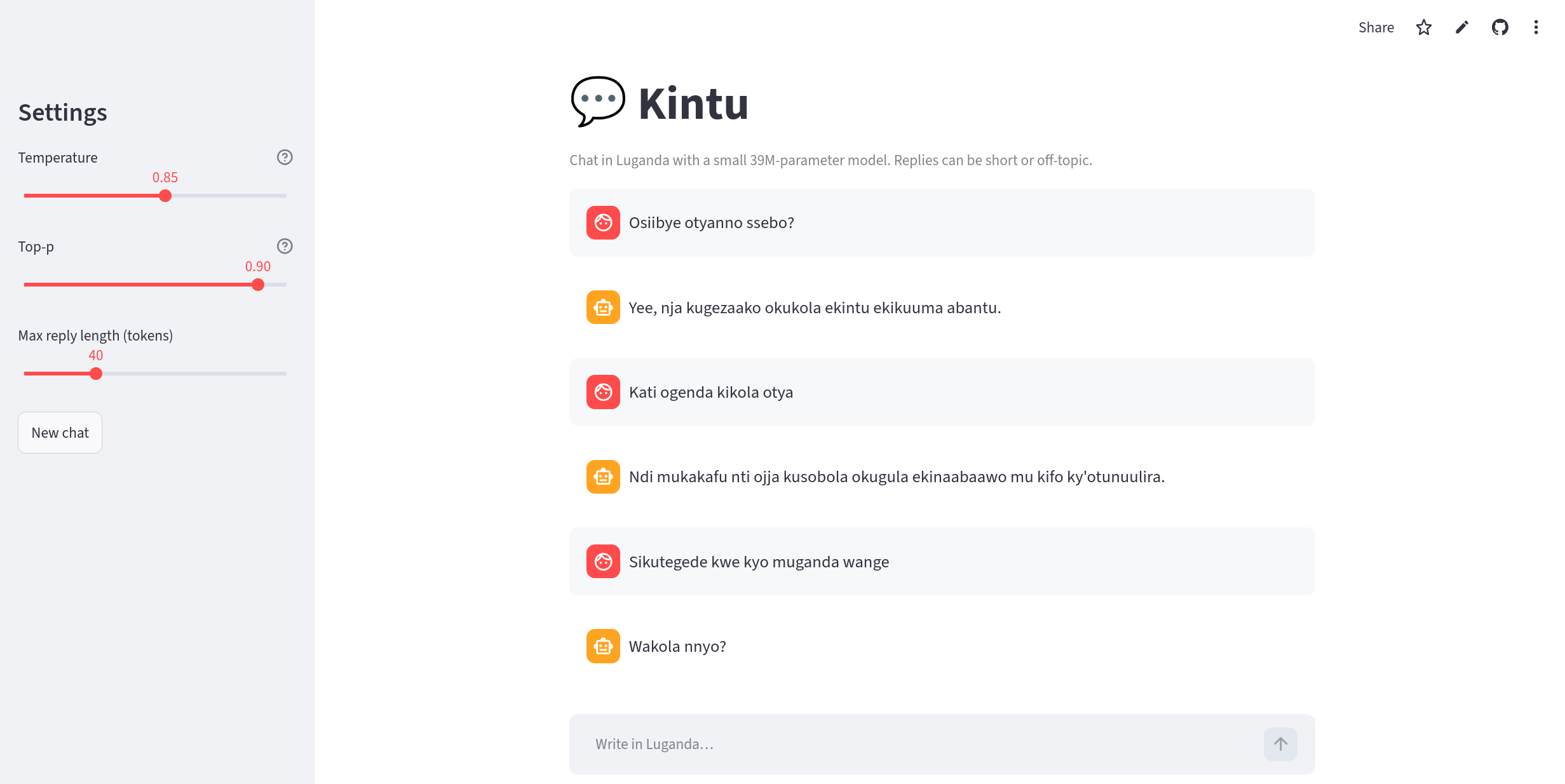
Kintu-2.0-30M is the second version of Kintu, my small Luganda chat model. Kintu-1.0 was a fine-tune of goldfish-models/lug_latn_10mb, a small Luganda GPT-2 model. This time I trained it from scratch with the MiniMind recipe. You can chat with it here.
What’s new
- Trained from scratch. It’s a Qwen3-style decoder with 8 layers, a hidden size of 512 and 30M parameters, a bit smaller than Kintu-1.0.
- Its own tokenizer. A 6,400-token byte-level BPE trained on Luganda text, instead of the 50k-token tokenizer Kintu-1.0 borrowed.
- Multi-turn chat. It uses a standard chat template, so it sees the whole conversation (up to 512 tokens), not just your last message.
- Apache 2.0. Kintu-1.0 was non-commercial only. Kintu-2.0 isn’t.
Three models
| Model | What it is |
|---|---|
| Kintu-2.0-30M-Base | The pretrained model. It continues text and doesn’t chat. |
| Kintu-2.0-30M | The base model fine-tuned on Luganda conversations. |
| Kintu-2.0-30M-Instruct | Kintu-2.0 fine-tuned further on multi-turn chats, then preference-tuned with DPO. |
Training
All of it ran on free Kaggle T4 GPUs.
- Pretraining. 273M tokens of luganda-pretrain2, a mix of Luganda web text, the Bible, translation data and Luganda TinyStories. 2 epochs on 2× T4 took 2.1 hours.
- Chat. 59,798 prompt-reply pairs from luganda-sft-translated and 685 conversations from luganda-lima.
- Instruct. More fine-tuning on luganda-chats and luganda-lima, then DPO on 13,659 preference pairs from luganda-ultrafeedback-dpo. Together these took about 13 minutes on one T4.
Using it
from transformers import AutoModelForCausalLM, AutoTokenizer

tok = AutoTokenizer.from_pretrained("henryhale/Kintu-2.0-30M-Instruct")
model = AutoModelForCausalLM.from_pretrained("henryhale/Kintu-2.0-30M-Instruct")

messages = [
    {"role": "system", "content": "Oli muyambi ow'amagezi ayamba abantu mu Luganda."},
    {"role": "user", "content": "Oli otya?"},
]
enc = tok.apply_chat_template(messages, add_generation_prompt=True, return_tensors="pt", return_dict=True)
out = model.generate(**enc, max_new_tokens=256, do_sample=True, temperature=0.4, top_p=0.8, repetition_penalty=1.2)
print(tok.decode(out[0, enc["input_ids"].shape[1]:], skip_special_tokens=True))
For phones there are ONNX exports with a KV cache, from 22.8 MB (4-bit) up to 127.4 MB (fp32).
What it can’t do
Kintu-2.0 writes fluent Luganda, but it often drifts off-topic and gets facts wrong. Most of its pretraining tokens (68.5%) come from translated TinyStories, so it leans towards simple stories. The chat data is mostly AI-written and machine-translated, and native speakers haven’t fully reviewed it yet. Don’t rely on it for information, especially on health, money or farming, and keep chats short.